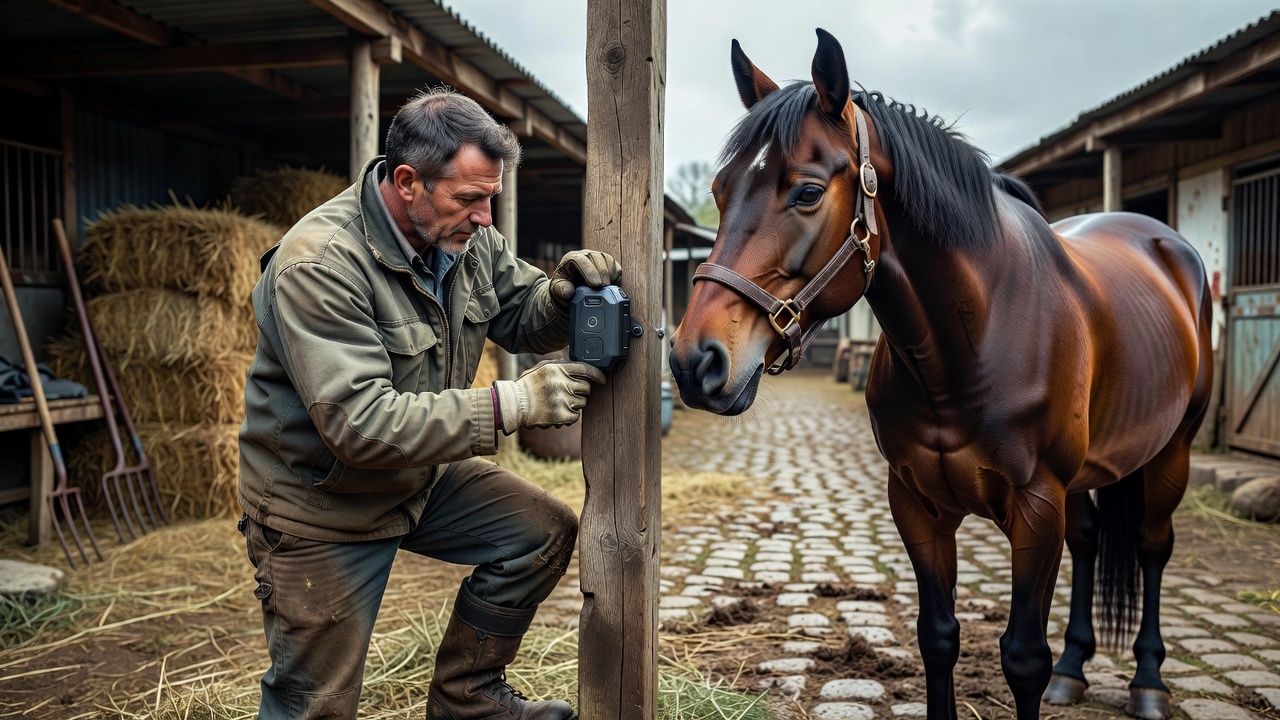
A horse returns from a session with a familiar rhythm, or perhaps one transition felt less settled than usual. A rider may notice a change in cadence, a difference between reins or a moment when the horse needed more time to organise. A training sensor can add a record to that impression. It cannot explain the whole moment on its own.
Equestrian sensors include inertial measurement units (IMUs), which use accelerometers and gyroscopes to describe movement, as well as heart-rate monitors, pressure-sensing systems and location tools. These instruments collect different kinds of information. A movement unit attached to tack may record changes in acceleration; a heart-rate system follows pulse under its own set of fitting and signal conditions. The useful question is not which device sounds most advanced, but which reading could help answer a practical question about a particular session.
Begin with a question, not a dashboard
Before choosing a device, write down what the rider or trainer wants to understand. Is the question about how long a session lasts, whether a pattern repeats across a familiar exercise, or how the work is distributed between left and right turns? A clearly bounded question makes it easier to decide what to record and what to ignore.
Choose the measure only after setting the question. A timer can be enough to compare work intervals. A movement sensor may help capture timing or repetition, but its labels and outputs depend on the device, its placement and the method used to process the signal. A sensor that records a number does not automatically make that number a direct description of comfort, training quality or soundness. Keep the measured variable separate from the interpretation placed on it.
Fit and repeatability come first
A device must be attached in a stable, consistent way. Note where it sits, which direction it faces, how it is secured and whether it was moved between sessions. A small shift can change what the sensor records. The same is true of a loose strap, a different saddle arrangement or a garment that changes how a unit sits against the body.
Follow the maker's fitting instructions and check that the attachment does not interfere with tack, movement or the horse's comfort. Record the equipment configuration beside the session data. If the device is shared among horses, keep a clear record of which horse, rider and unit were involved. Where a fitting concern arises, stop and resolve it rather than trying to interpret readings from an unstable setup.
Make a fair comparison
For a meaningful comparison, repeat a familiar task under conditions that are as similar as practical. Record the horse, rider, direction, exercise, duration, surface, warm-up and relevant equipment. Similar does not mean identical; it means the differences are visible in your notes rather than hidden in the graph.
Repeat observations are often more informative than a single striking value. Look for a pattern across sessions, and then check whether something changed in the context. Was one session on a recently watered surface? Was the horse asked to work in a different frame or at a different pace? Did the rider use another saddle or fit the sensor differently? Those details can help explain why readings vary without pretending to prove a single cause.
Read the trace beside the ride
Keep a rider's account, trainer's observation and the sensor record side by side. A simple note can include what was asked, what the horse did, what the rider felt, what the device measured and what remains uncertain. This practice helps prevent a chart from becoming a story that was never present in the arena.
Sensor apps may summarise data as counts, scores or coloured indicators. Read their definitions. Find out what is measured directly, what is calculated, how missing data is handled and whether a score is specific to a task. A clean display can be easy to scan, but visual confidence is not the same as measurement certainty. If a system does not clearly explain a metric, treat it as a prompt for a question rather than a conclusion.
Practical care and responsible use
Charge and inspect equipment according to its instructions. Check straps, clips, housings and contact points for wear, and keep devices clean in the way the manufacturer specifies. Protect recorded information: use only the data needed for the training purpose, keep access appropriate and avoid sharing identifiable session records without permission.
A sensor may support discussion among a rider, trainer, coach or equipment specialist. It is not a substitute for skilled observation, veterinary assessment or a professional fitting when those are needed. If a horse's behaviour or way of going raises a welfare concern, take the concern seriously and seek suitable professional guidance rather than relying on a device score. The best sensor is the one that helps a team ask a more careful question, repeat an observation responsibly and stay open to what the horse is showing.
What you observe
A change in rhythm, a difference in a familiar exercise or an uneven-feeling transition.
What a device may add
A repeatable record of a defined signal, collected with consistent fitting and notes.