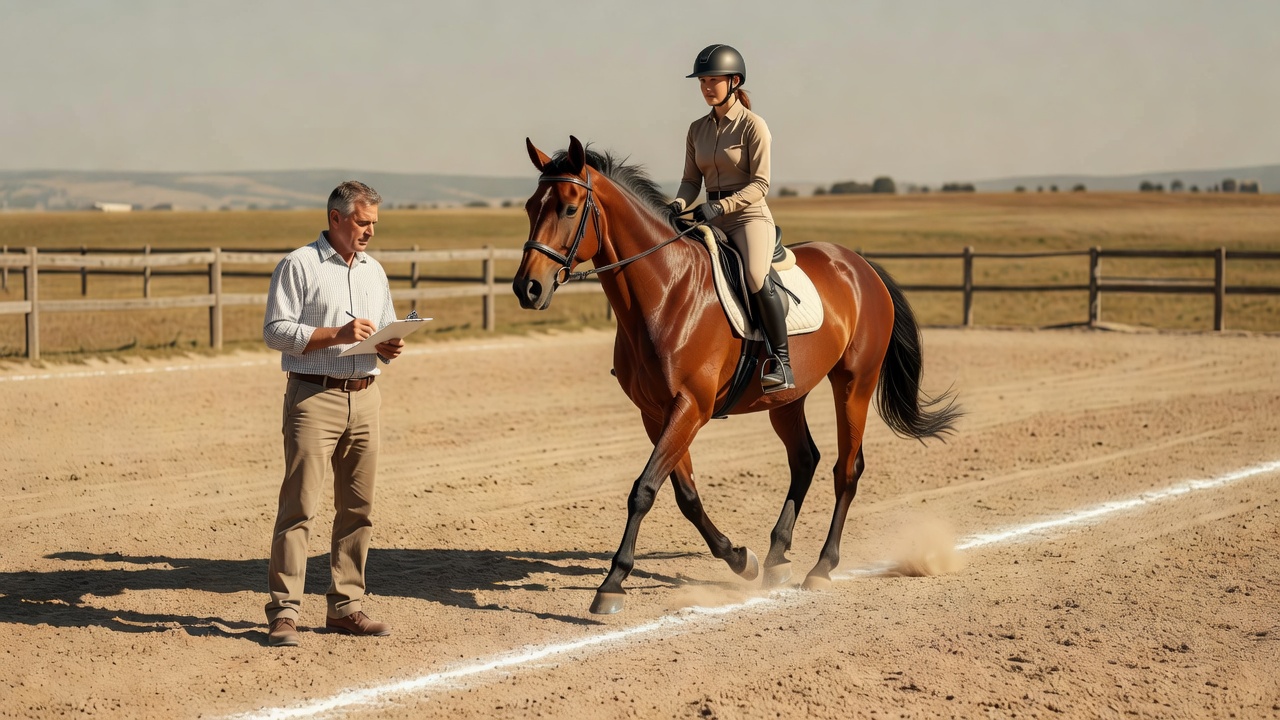
A horse's movement is not a single number. It is a sequence shaped by the task, surface, speed, direction, rider, equipment and moment in the session. A trainer may see a transition become less fluent, or a rider may feel a difference between reins. Video and sensor systems can help preserve details that are difficult to hold in memory, but each records only part of the picture.
Movement analysis includes human observation, video review and instrumented measurement. A camera records visible motion from one angle; a wearable device records signals at its own location; a pressure system represents contact through its sensors and processing. None should be mistaken for an all-seeing view. Begin by naming what was observed, where it appeared and under which conditions.
Choose a repeatable question
Ask a question that can be explored safely and clearly. Perhaps you want to compare a familiar transition in each direction, review a short sequence of a movement or note how a horse organises a particular exercise over several sessions. Avoid trying to analyse too many variables at once. The narrower the question, the easier it is to collect a useful record without changing the whole training session.
Set the task and observation method in advance. Mark a route, agree on a pace or use a consistent set of transitions if appropriate to the horse and training plan. Record the warm-up, surface, direction and equipment. The goal is not to force identical performance but to make the conditions legible. A useful comparison can still include differences—as long as those differences are known.
Use video with care
Video can help a rider and trainer revisit a sequence at normal speed and, where useful, examine selected frames. Keep the camera stable, position it consistently and make sure the horse is visible throughout the intended movement. A view that is too close, too oblique or interrupted by people and equipment can make a comparison misleading. Save the camera position and direction in your notes.
Slow motion changes how a movement is perceived. It may help examine timing, but it can also draw attention to a single frame that does not represent the whole stride or task. Review the sequence at ordinary speed first. If you share footage, consider the privacy of riders, staff and other people in the arena, and obtain permission where appropriate. Keep recordings securely and retain only what is needed.
Understand what a sensor represents
Wearable units can record acceleration, rotation or other signals at a particular attachment point. Software may derive timing, movement counts or comparative indicators from those raw signals. Pressure systems measure at specific points and depend on the placement, calibration and setup of their sensors. Before relying on a result, find out how it is produced and what its output is intended to represent.
Repeated readings can help identify a pattern worth discussing, but a pattern is not automatically an explanation. A difference might reflect task, rider, surface, fit, speed, device placement or signal quality. Record enough context to test plausible alternatives. If an output cannot be explained clearly, label it as uncertain rather than giving it a stronger meaning than the method supports.
A simple observation-and-interpretation routine
Observation
“On the second left rein, the transition took longer to settle than on the first.” Record the visible or felt event without adding a cause.
Interpretation
“The difference may relate to the task, the rider's aids, surface or another condition.” List possibilities and decide what can be checked next.
This separation is useful in conversation. The rider can describe sensation, the trainer can add what they saw, and the technology can contribute a clearly defined measurement. If all three accounts are written separately before being discussed, it becomes easier to notice agreement and difference without allowing one source to dominate.
Build comparisons, not verdicts
One session is a snapshot. Look across repeated, reasonably comparable sessions before treating a variation as a stable pattern. Keep the files or notes clearly dated, name the task and preserve the setting information. If a device or camera setup changes, mark the change rather than silently combining unlike records.
Do not use a general-purpose movement tool as a medical diagnosis. A chart cannot determine why a horse moves in a particular way, and automated labels may not capture the full task. If you have a welfare concern or a horse's movement changes in a way that worries you, seek appropriate professional assessment. Technology can help make a conversation more specific; it does not replace the expertise required to interpret a concern.
Turn the record into a better next step
At the end of a review, write down what is known, what remains unclear and what would be reasonable to observe next. Perhaps the next session repeats the same exercise on the same surface, or perhaps the team checks an equipment fit before comparing movement again. Make only changes that suit the horse and the training plan.
The value of analysis is often modest but real: a remembered moment becomes a more precise account; a hunch becomes a question that can be checked; a trainer and rider gain a shared reference point. Keep the horse's response at the centre. A tool should add context to careful horsemanship, not turn a living, adapting partnership into a score.