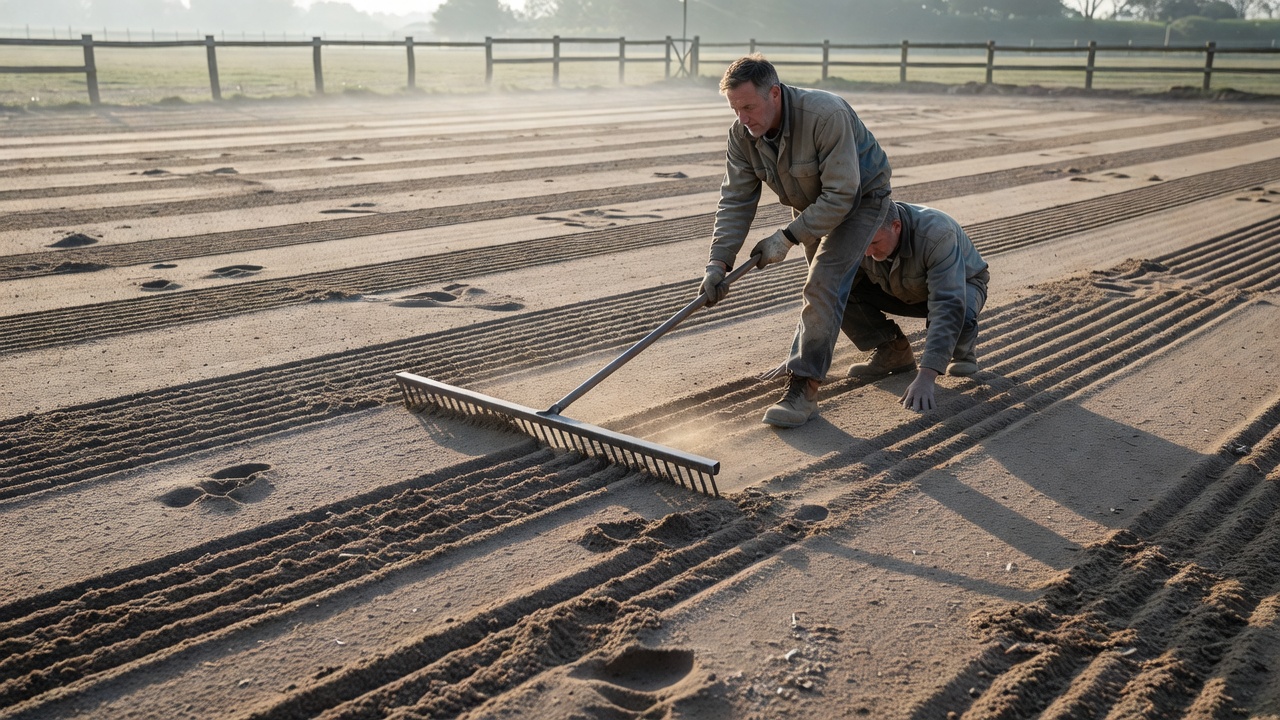
A rider may notice that hoofprints look deeper along one track, that a corner seems looser after a busy morning, or that a horse takes a different step where the arena has been watered. Those observations are useful starting points. Footing is not a fixed ingredient list: the riding surface changes as materials shift, moisture moves, weather changes and horses work across it.
To understand what is under hoof, begin by identifying the construction and maintenance history. Some arenas use sand alone; others combine sand with fibre, rubber, textile or other additives. The base, drainage, depth, particle shape and maintenance method all influence how the surface behaves. Two arenas with similar-looking sand can feel quite different, while one arena can vary from its centre to its edge.
Separate the visible clues
Look across the whole arena before riding. Notice whether the surface is level, whether tracks have formed, whether water gathers in low areas and whether the material looks dry, crusted, fluffy or packed. Check for visible contamination and report concerns to the person responsible for the facility. An arena walk is not a laboratory test, but it provides a useful record of what has changed.
Moisture matters, but a damp-looking top layer does not establish that moisture is even through the working depth. Watering, drainage, air temperature and surface composition influence how it distributes. A maintenance log can record when the arena was watered, harrowed or levelled, alongside weather and usage. Paired notes help make sense of a rider's impression later in the day.
What a surface check can—and cannot—tell you
Simple checks, such as observing hoofprints, walking a consistent route or using a facility's established depth and moisture checks, can reveal variation. They do not by themselves establish how the surface will respond under every horse, speed or movement. Hoof size, shoeing, load, pace and turning forces interact with the ground. Treat a check as one piece of evidence and follow the surface supplier's and arena manager's maintenance guidance.
Technology can support the process. Moisture meters, depth measurements and maintenance records may help staff compare places and dates, provided the method is consistent and the tool is suitable for the material. Mark where and when a reading is taken. A number without a location, depth or method is difficult to interpret. Similarly, a camera or sensor used during a ride may show an event, but it cannot independently identify the composition or condition below the hoof.
Comparison at a glance
| Surface feature | What to observe | Useful context |
|---|---|---|
| Sand blend | Visible particle size, displacement and level | Supplier specification, depth and recent maintenance |
| Fibre additive | Distribution, clumping and surface consistency | Blend type, age and care instructions |
| Moisture | Dry patches, pooling or visibly uneven areas | Watering time, weather, drainage and sampling method |
| Use and traffic | Tracks, ridges and heavily worked zones | Number of sessions, direction of travel and levelling |
Maintenance is a routine, not a one-off fix
Regular levelling can redistribute material and reduce the development of pronounced tracks. Watering plans are specific to the surface and local conditions; follow the arena's established procedure rather than applying a generic schedule. Keep notes on harrowing, levelling, additions, repairs and unusual weather. Consistency makes a maintenance history more valuable than a collection of isolated impressions.
Staff can divide the arena into simple reference zones and record observations in the same order. If instruments are used, note the device, its setup, exact spot, date and timing relative to maintenance. Repeat measurements using the same method. If readings conflict with what a careful walk suggests, investigate the method and the location before drawing a conclusion. A measurement is only as useful as its sampling plan.
Bring footing back into the training conversation
When a session feels different, record the task and the surface conditions together. Was the work on a straight line, a circle or a corner? Was it in the same direction? How long after watering did the horse go in? Was the area freshly levelled? Those details help a rider and trainer separate a change in exercise from a change in environment.
Footing observations should not become a shortcut to diagnosing a horse's movement or predicting injury. If the surface looks unsafe, pause use and tell the responsible yard or facility manager. If the horse's way of going raises concern, involve the appropriate professional. A well-kept log can support informed decisions, but it cannot replace practical inspection or skilled judgement. Good arena technology serves the routine: it helps the team remember what was done, where a change appeared and what needs a closer look.
What you observe
Tracks, moisture, depth variation, loose patches or the way maintenance has altered a zone.
What records may add
A repeatable history of place, timing, maintenance method and measured conditions.